
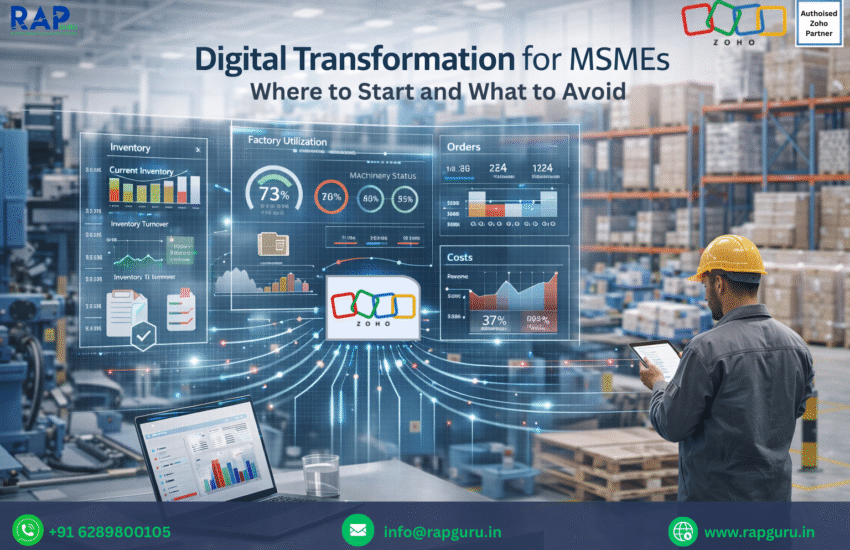
Understanding it through a case study.
Digital transformation is no longer a buzzword reserved for large enterprises. For MSMEs, it has become a business necessity—driven by compliance requirements, competitive pressure, customer expectations, and the need for operational efficiency.
However, many MSMEs struggle not because technology is unavailable, but because they start in the wrong place or make avoidable mistakes.
This article outlines a practical roadmap for MSMEs to begin their digital transformation journey—along with common pitfalls to avoid.
Why Digital Transformation Matters for MSMEs
For MSMEs, digital transformation is not about adopting the latest tools. It is about:
- Gaining real-time visibility into operations and finances
- Reducing dependency on manual processes and spreadsheets
- Improving compliance, accuracy, and audit readiness
- Enabling scale without proportionally increasing manpower
- Creating a better customer and employee experience
When done right, digital transformation directly impacts profitability, control, and resilience.
Where MSMEs Should Start
1. Start with Core Business Processes, Not Technology
The biggest misconception is that digital transformation starts with buying software. In reality, it starts with process clarity.
Before adopting any platform, MSMEs should answer:
- How do leads move from enquiry to conversion?
- How are invoices raised, payments tracked, and reconciled?
- How are employees onboarded, paid, and evaluated?
- Where are delays, errors, and duplications happening?
Digitising broken or unclear processes only accelerates inefficiency.
2. Prioritise Finance and Compliance First
For most MSMEs, finance is the backbone. Digitising finance brings immediate, measurable benefits.
Implementing a cloud-based accounting system like Zoho Books helps MSMEs:
- Automate GST compliance and e-invoicing
- Track receivables and payables in real time
- Simplify bank reconciliation
- Prepare audit-ready financials
Starting with finance creates a strong digital foundation for other functions.
3. Build a Single Source of Truth for Customers
Customer data scattered across Excel files, emails, and WhatsApp messages leads to missed follow-ups and revenue leakage.
A CRM platform such as Zoho CRM allows MSMEs to:
- Centralise leads, contacts, and deals
- Automate follow-ups and reminders
- Track sales performance objectively
- Improve customer experience through timely communication
CRM should be implemented as a sales discipline, not just a contact database.
4. Integrate, Don’t Isolate
Digital transformation succeeds when systems talk to each other.
For example:
- CRM integrated with accounting ensures accurate invoicing
- Payroll integrated with HR reduces compliance risk
- Sales data integrated with analytics improves forecasting
Platforms like Zoho One are designed to eliminate silos and provide end-to-end visibility without enterprise-level complexity.
5. Automate Gradually, But Intentionally
Automation does not mean replacing people. It means:
- Removing repetitive manual work
- Reducing dependency on individuals
- Minimising human error
Low-code platforms such as Zoho Creator enable MSMEs to automate approvals, reporting, and workflows without heavy IT investment.
The key is to automate high-impact, high-frequency tasks first.
What MSMEs Should Avoid
1. Buying Too Many Tools Too Quickly
Using multiple disconnected tools often leads to:
- Higher costs
- Data inconsistency
- User fatigue
- Poor adoption
More software does not mean better transformation. Fewer, well-integrated systems deliver superior outcomes.
2. Ignoring Change Management
One of the most common reasons for failure is resistance from teams.
Digital transformation fails when:
- Users are not trained properly
- Processes are changed without explanation
- Leadership does not enforce adoption
Successful transformation requires leadership involvement, training, and accountability.
3. Treating Digital Transformation as a One-Time Project
Digital transformation is not a one-off implementation. It is a continuous journey.
Businesses that succeed:
- Review processes periodically
- Use data to improve decisions
- Continuously optimise workflows
Technology should evolve alongside business growth.
4. Implementing Without Expert Guidance
Software alone does not guarantee success. Poor configuration, lack of process mapping, and improper integration often result in underutilised systems.
Working with experienced implementation partners ensures:
- Faster go-live
- Correct system design
- Higher ROI
- Long-term scalability
A Practical Roadmap for MSMEs
A realistic digital transformation roadmap looks like this:
- Assess current processes and pain points
- Digitise finance and compliance first
- Implement CRM for sales visibility
- Integrate HR, payroll, and operations
- Introduce automation and analytics
- Continuously optimise and scale
This phased approach reduces risk and maximises adoption.
Final Thoughts
Digital transformation is no longer optional for MSMEs—it is essential for survival and sustainable growth.
The right approach is not about adopting the most tools, but about building a connected, process-driven, and data-led organisation.
When MSMEs start with clarity, choose integrated platforms, and focus on adoption, digital transformation becomes a competitive advantage, not a cost burden.
Understanding through A Case Study: A Manufacturing MSME Gaining ERP-Like Control Without ERP Cost
Company Profile
- Engineering components manufacturer
- Annual turnover ₹40–50 crore
- Multiple vendors, dealers, and inventory locations
Challenges
- Inventory mismatches and valuation issues
- Poor visibility into dealer orders and receivables
- Manual purchase approvals causing delays
- No real-time profitability or cost insights
Zoho Solution Implemented
- Zoho Books for integrated accounting and inventory
- Zoho CRM for dealer management and order tracking
- Zoho Creator for custom purchase approvals and production reporting
- Analytics dashboards for management reporting
Outcomes
- Accurate real-time inventory and working capital visibility
- Faster order processing and improved dealer satisfaction
- Reduced procurement delays through automated approvals
- ERP-like operational control at a fraction of traditional ERP cost
Key Takeaway for Manufacturers
Zoho enables manufacturing MSMEs to achieve control, traceability, and scalability without heavy ERP investment

